
Opener Acting Up? Let's Figure Out What's Actually Wrong.
Here's something most opener "problems" have in common: half the time, it isn't the opener at all. A door with a weakening spring or a dragging track makes the opener work twice as hard, and the opener gets blamed. We always diagnose the whole system first — because replacing a $500 opener when you needed a $200 spring adjustment is the kind of thing that should never happen to you.
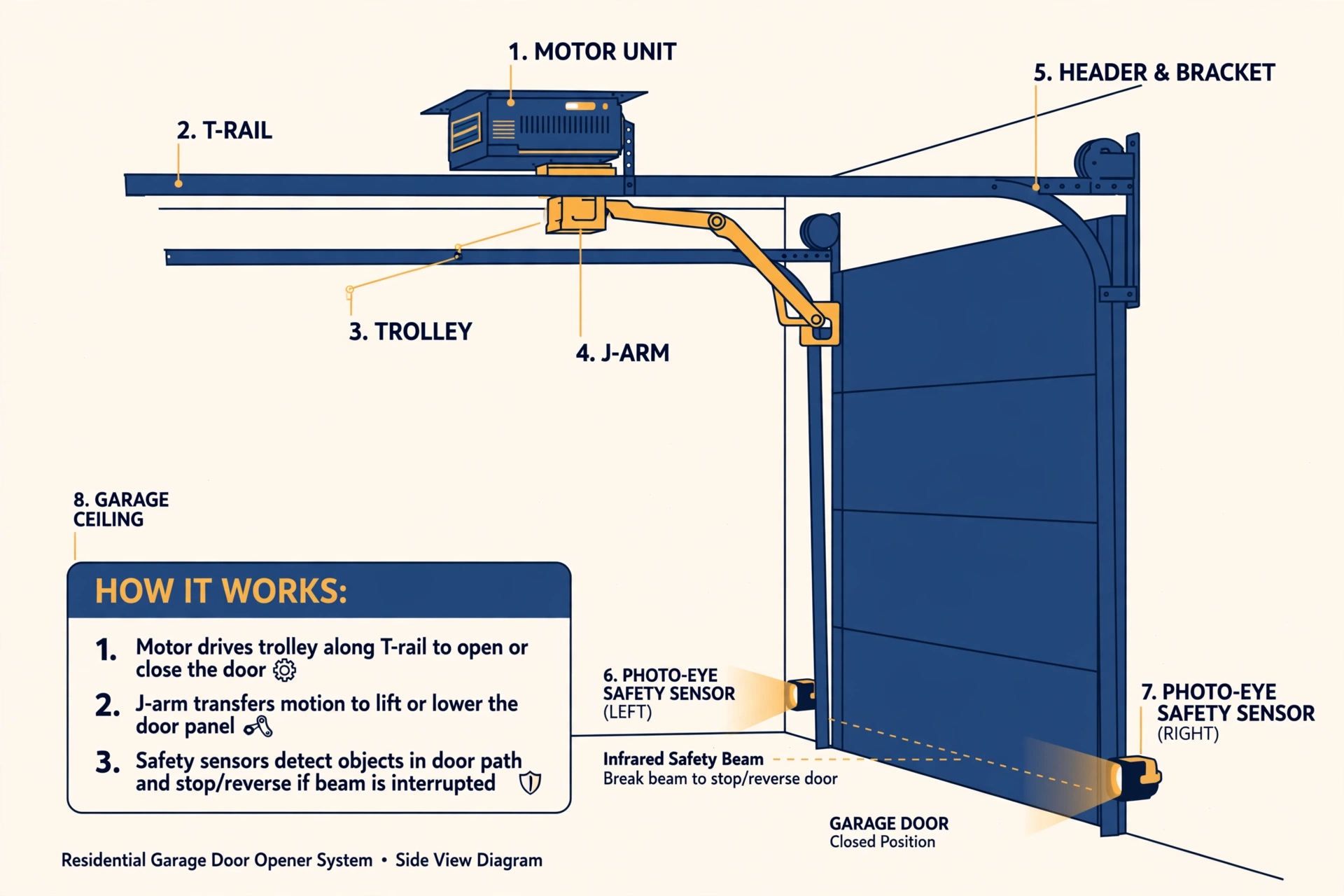
The opener system: motor unit, rail, trolley, and the safety sensors that cause most "mystery" problems.
The 30-second test you can do yourself
Before you call anyone, do the disconnect test:
- Pull the red emergency release cord (with the door fully closed).
- Lift the door by hand. It should move smoothly and stay put halfway open.
- If it's heavy, jerky, or slams down — the door is the problem, not the opener. Start with the spring page.
- If the door glides fine by hand but the opener won't move it — the opener is the problem, and the fix is usually straightforward.
Opener problems we fix every week
- Door reverses "for no reason." Almost always the photo-eye sensors — bumped out of alignment, dusty, or blocked. We realign and clean them, and check the close-force setting.
- Humming but not moving. Stripped gear in the motor unit (common on older chain-drive openers) or a seized trolley. Gear kits are a $150–$250 repair vs. a full replacement.
- Remote/keypad dead. Sometimes it's the battery. Sometimes the logic board. We test before we replace — boards run $150–$250 installed.
- Works in the morning, not in the afternoon. Heat expansion in a west-facing Gastonia garage can throw marginal sensors and limits off. Realignment plus fresh lubrication usually settles it.
- Ancient opener, no safety sensors. Pre-1993 openers lack the photo-eye reversal system that's been federal law for 30+ years. We don't repair these — we replace them, for your family's safety.
When replacement makes more sense
If your opener is 12–15 years old, uses a loud chain drive, and the repair quote is climbing past $250, a new unit is usually the smarter money. What we'd install for our own homes:
- Belt-drive openers ($450–$650 installed) — dramatically quieter, which matters if there's a bedroom over the garage. Most Gastonia ranch homes have exactly that layout.
- Wall-mount (jackshaft) openers ($600–$750 installed) — free up ceiling space and run nearly silent. Great for garages with storage racks or low ceilings.
- Smart openers with battery backup — phone control, and the door still works when a summer thunderstorm knocks out Duke Energy.
Straight answers
How long should a garage door opener last?
10–15 years for a quality unit. Chain drives tend to need gear or chain work around year 8–10; belt drives usually run quieter for longer with less maintenance.
Can you program my car's HomeLink or a new keypad?
Yes — keypad and HomeLink programming is included free with any opener install or repair visit, and we'll walk you through adding a second car.
Do you work on all opener brands?
LiftMaster, Chamberlain, Craftsman, Genie, and most others. If parts are discontinued for a very old unit, we'll tell you upfront rather than charging for a doomed repair.